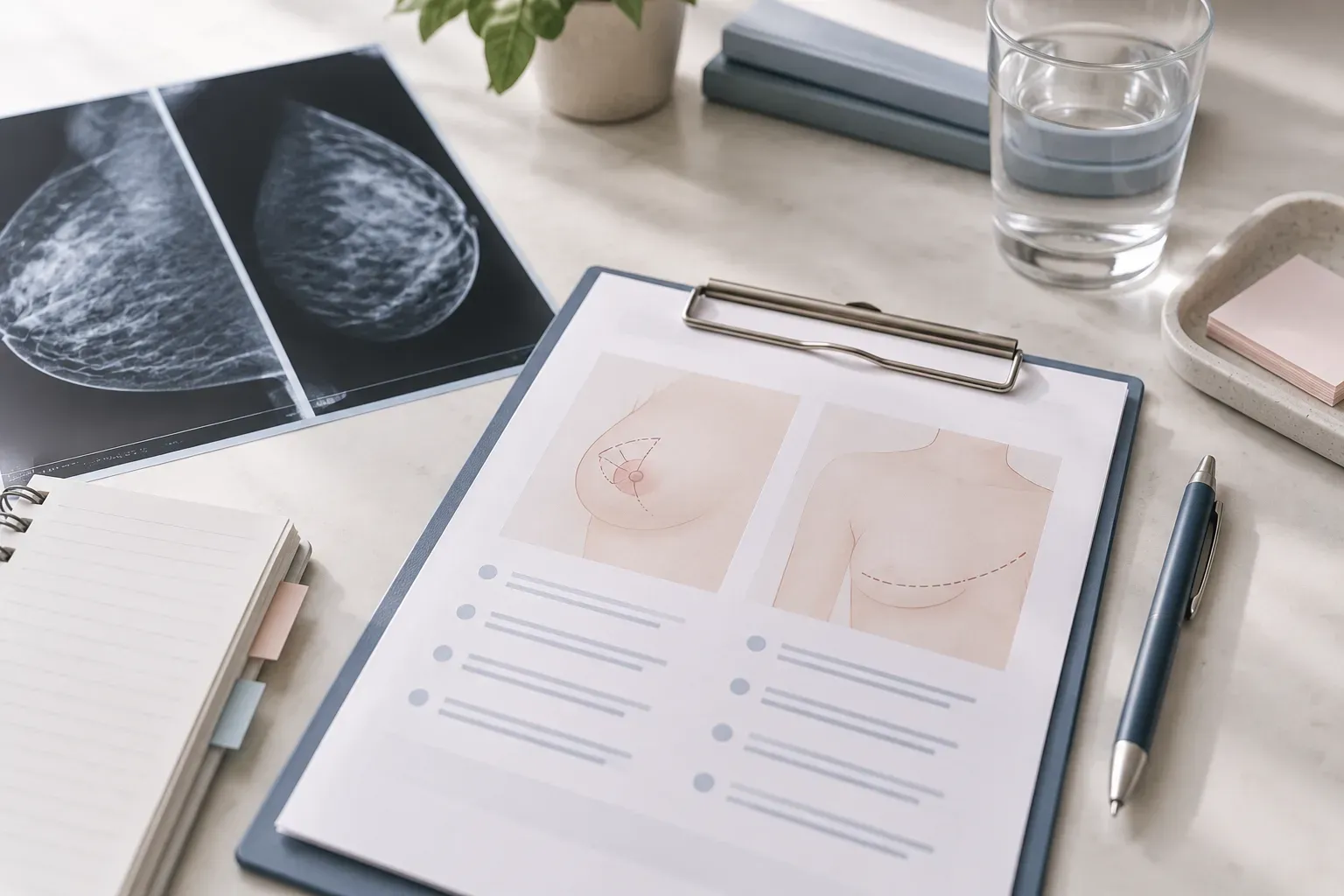
Choosing between a lumpectomy and a mastectomy just days after a cancer diagnosis is overwhelming. Without a medical background, being asked to make that decision can feel like playing high-stakes roulette with your life.
But there is a crucial fact that reframes the entire choice: for early-stage breast cancer, long-term survival rates for lumpectomy plus radiation and mastectomy are virtually identical. Decades of research confirm this. In most cases, you aren’t choosing the option that keeps you alive, you’re choosing the physical, emotional, and recovery path that fits your life best.
Below, we walk through how both procedures work, the key differences in recovery and recurrence risk, circumstances where a choice isn’t an option, and how to make the right decision for you.
Demystifying the Two Surgeries: What Each One Involves
What Is a Lumpectomy?
A lumpectomy (also called breast-conserving surgery or partial mastectomy) removes the tumor along with a safety margin of healthy surrounding tissue, leaving the rest of the breast intact.
- The Procedure: Typically an outpatient surgery under general anesthesia lasting 1 to 2 hours. Most patients go home the same day.
- The Follow-Up: Lumpectomy is almost always followed by radiation therapy to the remaining breast tissue, usually starting a few weeks post-surgery once healing is underway. Combined, these two steps are known as breast conservation therapy. Radiation is a non-negotiable part of this path and we’ll explain why below.
What Is a Mastectomy?
A mastectomy removes all breast tissue from the affected side. Depending on your anatomy and goals, there are three primary approaches:
- Total (Simple) Mastectomy: Removes the entire breast, including the nipple-areolar complex.
- Skin-Sparing Mastectomy: Preserves the breast skin envelope, making immediate reconstruction smoother.
- Nipple-Sparing Mastectomy: Preserves both the skin and nipple-areolar complex, provided cancer cells are not present near the nipple.
Mastectomy generally requires an overnight hospital stay (sometimes longer) and temporary surgical drains for one to two weeks post-op.
Reconstruction & Lymph Node Evaluation
- Reconstruction Options: Breast reconstruction can happen simultaneously with the mastectomy (immediate) or months to years later (delayed). It can be done using implants or autologous tissue (flaps using your own tissue from the abdomen, back, or thighs). Choosing not to reconstruct going “flat” is an equally valid path.
- Lymph Node Checking: Both procedures almost always include evaluating the lymph nodes typically via a sentinel node biopsy, where only the first few draining nodes are removed and tested to see if the cancer has spread.
The Survival Question: What the Research Actually Shows
If there is one section to read closely, it’s this one because it tackles the core fear behind the entire decision: Which choice keeps me alive?
The Evidence That Set the Standard
During the 1970s and ’80s, landmark trials like the NSABP B-06 study followed thousands of women over decades. At the 20-year mark, overall survival was virtually identical: 47% for total mastectomy versus 46% for lumpectomy plus radiation. Major European trials (including the Milan and EORTC studies) reached the exact same conclusion, showing matching 10-year survival rates of 71% across both groups.
What Newer Studies Suggest
In recent years, registry analyses encompassing over 1.5 million real-world patients have actually shown higher survival rates among women who had a lumpectomy with radiation compared to those who had a mastectomy.
While reassuring, these numbers require context: women who undergo lumpectomies in real-world settings are often younger, healthier overall, and diagnosed with smaller tumors. Therefore, the apparent advantage is likely driven by patient health factors rather than the surgery itself.
The Takeaway
Medical guidelines have remained firm for over 30 years: for early-stage breast cancer, both options offer identical long-term survival.
It is easy to fall into the trap of thinking a mastectomy is “safer” simply because it is more aggressive. But in modern oncology, more surgery does not equal more cure.
The Real Trade-Offs: Radiation, Recurrence, and Repeat Surgery
If survival is equivalent, your choice comes down to practical, physical, and surgical trade-offs. Here are the five key factors that distinguish the two paths:
Lumpectomy recovery is typically faster. Most people are back to light activity within days and to normal routines within one to two weeks, with radiation beginning afterward.
Mastectomy recovery usually runs three to six weeks, longer with reconstruction, which may involve multiple procedures over months. Drains need managing at home. There’s usually permanent numbness across the chest wall, which few people are warned about and many find unexpectedly disorienting.
Ongoing monitoring differs. After a lumpectomy, you’ll continue having mammograms on that breast. After a mastectomy, there’s no breast tissue left to image on that side, so surveillance looks different.
Body image and sensation are genuinely different experiences, and research on long-term quality of life has tended to favor breast conservation. People’s priorities vary enormously, though, and some feel real relief at the idea of removing the tissue entirely. Neither reaction is the wrong one.
Nuance and Complexity: Factors That Can Shift Your Decision
While many women are candidates for either procedure, several key clinical factors can complicate or redefine the decision.
When Breast Conservation Isn’t Possible Sometimes a lumpectomy is simply off the table. This usually occurs if cancer is present in multiple distinct regions of the breast, if the tumor is too large relative to your breast size, if you’ve previously received chest radiation, or if clear margins cannot be achieved. It is also contraindicated during pregnancy when radiation would pose a risk to the fetus. If tumor size is the main hurdle, ask your team about neoadjuvant chemotherapy shrinking the tumor before surgery often makes breast conservation possible.
The Myth of Removing the Healthy Breast Rates of contralateral prophylactic mastectomy removing the healthy, cancer-free breast alongside the affected one have climbed steadily. For most women without a genetic predisposition, research shows this extra step does not improve long-term survival. It increases surgical time and complication risks without offering a survival advantage.
The calculus changes dramatically, however, if you carry a high-risk gene mutation like BRCA1 or BRCA2, where the risk of a brand-new primary cancer in the second breast is genuinely elevated.
Why Genetic Testing Comes First If you haven’t undergone genetic testing and have a personal or family history suggesting a hereditary link, request testing before scheduling surgery. Learning you carry a high-risk mutation can shift your best option from a lumpectomy to a double mastectomy.
Navigating Differences in Surgical Style Medicine is both science and art, and reasonable surgeons can disagree. How comfortably a surgeon handles borderline cases, their expertise in oncoplastic techniques (reshaping the breast tissue during tumor removal), and how they counsel younger patients vary between medical centers. Getting a second opinion is a standard, completely uncontroversial part of cancer care that can provide valuable clarity.
Next Steps: Questions and Clarity for Your Decision
Bringing direct, specific questions to your consultation helps cut through the noise and gives you control over the process.
Essential Questions for Your Surgeon:
- “Am I a candidate for both procedures, or are there clinical reasons one isn’t realistic?”
- “If we do a lumpectomy, what is the chance I’ll need a second operation to achieve clear margins?”
- “If I choose a mastectomy, could I still require radiation therapy afterward?”
- “Given the tumor’s size and location, what will my breast look like after a lumpectomy?”
- “Should we perform genetic testing before committing to a surgical plan?”
- “What reconstruction options are open to me, and how does timing impact our choices today?”
Three Important Steps Before Finalizing Your Choice:
- Give yourself permission to pause. Breast cancer surgery is almost never an immediate emergency. Requesting a week or two to absorb the information, talk with loved ones, and obtain a second opinion is standard, safe, and expected.
- Meet with a plastic surgeon. If you are considering a mastectomy, schedule a consultation with a reconstructive specialist before surgery even if you are leaning toward going flat. It is far easier to understand your options beforehand than to navigate them retroactively.
- Honor your personal priorities. Whether your priority is avoiding daily radiation travel, minimizing recovery time, preserving tissue sensation, or reducing future imaging anxiety these are legitimate clinical inputs.
A Final Word
Hold fast to the landmark finding behind all of this: you are not choosing between living and dying. You are choosing between two equally safe, medically proven paths that simply ask different things about your body and routine. That makes your values and priorities a vital part of the equation and it means whichever path you choose, it is the right one for you.
This page describes surgical options for breast cancer in general terms and cannot tell you which is appropriate for you. Eligibility depends on tumor size and location, whether the cancer appears in more than one area, lymph node status, genetic test results, previous radiation, and your breast size and anatomy. The equivalence of survival described here applies to patients who are candidates for both operations, which is not everyone. Nothing on this page should be used in place of a discussion with your surgical and oncology team, and decisions about radiation, reconstruction, and genetic testing belong with them.
Common questions
Is a mastectomy safer than a lumpectomy for early-stage breast cancer?
No. For early-stage breast cancer, long-term survival rates for lumpectomy plus radiation and mastectomy are virtually identical, and medical guidelines have held that position for over 30 years. A mastectomy is more surgery, but more surgery does not equal more cure.
Do I need radiation after a lumpectomy?
Almost always. Lumpectomy is followed by radiation therapy to the remaining breast tissue, usually starting a few weeks after surgery once healing is underway. Together the two steps are called breast conservation therapy.
When is a lumpectomy not an option?
Usually when cancer is present in multiple distinct regions of the breast, the tumor is too large relative to your breast size, you have previously received chest radiation, or clear margins cannot be achieved. It is also contraindicated during pregnancy when radiation would pose a risk to the fetus. If tumor size is the main hurdle, chemotherapy before surgery can often shrink the tumor enough to make breast conservation possible.
Does removing the healthy breast improve survival?
For most women without a genetic predisposition, research shows that removing the healthy breast does not improve long-term survival, and it increases surgical time and complication risks. The calculus changes for people who carry a high-risk mutation such as BRCA1 or BRCA2.
Should I have genetic testing before breast cancer surgery?
If you have a personal or family history suggesting a hereditary link, request testing before scheduling surgery. Learning you carry a high-risk mutation can shift your best option from a lumpectomy to a double mastectomy.
Sources
- Twenty-year follow-up of a randomized trial comparing total mastectomy, lumpectomy, and lumpectomy plus irradiation for the treatment of invasive breast cancer · New England Journal of Medicine, 2002 · doi:10.1056/NEJMoa022152
- Ten-year results of a comparison of conservation with mastectomy in the treatment of stage I and II breast cancer · New England Journal of Medicine, 1995 · doi:10.1056/NEJM199504063321402
- Research table: Lumpectomy plus radiation therapy versus mastectomy for early breast cancer treatment · Susan G. Komen, 2025
- Lumpectomy Versus Mastectomy for Early-Stage Breast Cancer: Are they Equally Effective? · Current Breast Cancer Reports, 2025 · doi:10.1007/s12609-025-00617-x
- Decision Making in the Surgical Management of Invasive Breast Cancer-Part 1: Lumpectomy, Mastectomy, and Contralateral Prophylactic Mastectomy · CancerNetwork, 2017
- Lumpectomy Plus Radiation Offers Better Survival Rates Than Mastectomy for Early-Stage Breast Cancer · Breastcancer.org, 2021
- Superior survival for breast-conserving therapy over mastectomy in patients with breast cancer: A population-based SEER database analysis across 30 years · Frontiers in Oncology, 2023 · doi:10.3389/fonc.2022.1032063
- Pathologic evaluation of lumpectomy resection margins for invasive breast cancer: a single institution’s experience · International Journal of Clinical and Experimental Pathology, 2023
- Success rates of re-excision after positive margins for invasive lobular carcinoma of the breast · npj Breast Cancer, 2019 · doi:10.1038/s41523-019-0125-7
- Breast Conserving Therapy Versus Mastectomy: Outcomes Across Different Clinical Characteristics · Current Breast Cancer Reports, 2026 · doi:10.1007/s12609-026-00660-2
- Mastectomy · American Cancer Society, 2026
- Does Breast-Conserving Surgery with Radiotherapy have a Better Survival than Mastectomy? A Meta-Analysis of More than 1,500,000 Patients. · Annals of Surgical Oncology, 2022 · doi:10.1245/s10434-022-12133-8